People Behind Sustainability – Edgar Mächler
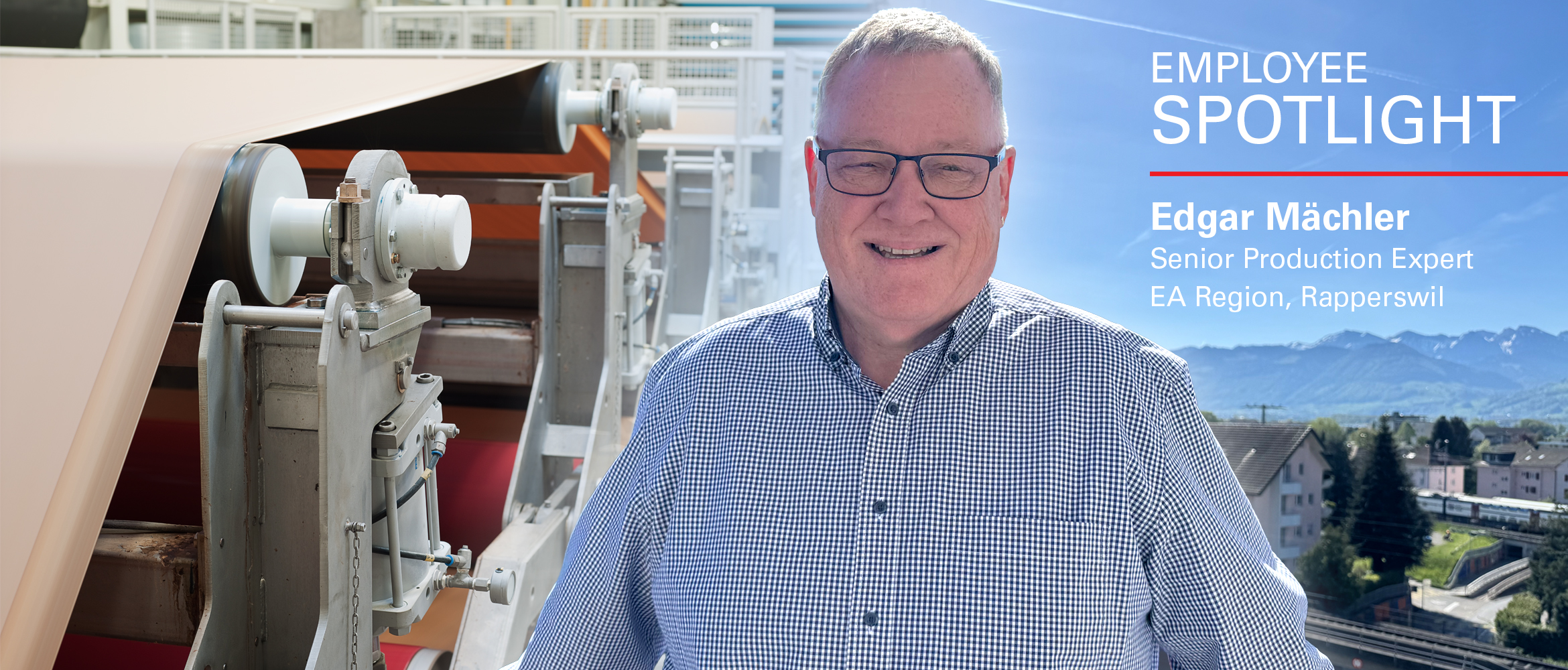
Edgar Bruno Mächler is the Senior Production Expert for the EA region at Weidmann Electrical Technology. He has been employed with Weidmann for 47 years and is based in Rapperswil, Switzerland. Edgar began at Weidmann in April 1979 as an apprentice in the mechanical workshop. With his energy and willpower, he enjoyed having a long journey of sustained growth together with his colleagues. With 47 years of dedication, Edgar is among the three longest-standing employees at Weidmann and holds the record for the longest continuous period of employment!
Please introduce yourself in a few sentences.
I’ve been with Weidmann for 47 years. Today, I’m a Senior Production Expert for the EA region at Weidmann Electrical Technology in Rapperswil. I have a strong connection with nature: I spend a lot of my free time in the mountains and forests – I’m not a city person. Hiking in nature, where no cable car goes, is my way to relax. Tours on my e-bike also bring me a lot of joy, and in winter, I naturally use the cable cars for skiing.
Tell us about your journey at Weidmann. What made you stay with Weidmann through all these years?
My journey at Weidmann has been very diverse. Following my apprenticeship as a mechanic, I worked in various areas: in project management for customer projects, and later as production manager in Rapperswil. The first advancement happened during my fourth year of apprenticeship when illness-related absences in the quality department opened an appealing position in manufacturing development. For me, it was already clear that following my apprenticeship, I didn’t just want to produce series parts at a machine but rather broaden my education and continue developing. That’s when I decided to pursue further education in mechanical engineering at the engineering school in Zurich, and then went into project work in production development. In 2003, I moved to production management and helped with the establishment of the Winding Package production. In 2015, I switched to Board production, and today I’m a Senior Production Expert EA, helping to ensure all processes run as smoothly as possible while passing on my knowledge to the next generation.
What kept me here? The opportunity to develop broadly, get to know different areas, and actively help shape things. I was repeatedly able to take on new challenges – sometimes in sales, sometimes in production, sometimes in project or product management. This allowed me to build a broad wealth of experience.
What advice would you have for young people about to embark upon their apprenticeship at Weidmann or other companies to have such a long, sustained, and successful journey with their employer?
I wouldn’t focus on the idea that you must spend your entire career with one employer – but simply: Do what brings you joy. Not something that doesn’t suit you. Keep developing yourself. It doesn’t always have to be the same employer – you can also gain experience by leaving and coming back.
What’s important from my perspective: Go broad. Don’t stay in just one lane; try something different, too. In your younger years, you can afford to do that. If after three to four years it no longer fits, then feel free to do something else – that’s also possible at Weidmann. Gain experience and build a broad wealth of knowledge that you can apply in any situation.
And: Treat everyone as equals. Everyone has their strengths – a machine operator knows the equipment better than their supervisor. Respect and appreciation are essential. When this is lived globally, everyone feels comfortable in their environment, with their colleagues, and this is crucial so that everyone approaches their work with joy each day and can give their best. Because: Together as a team, we are strong!
How does sustainability align with your personal values?
I spend a lot of time outdoors, in the mountains and forests. I draw much of my energy from nature, and it inspires me to live sustainably and in harmony with nature in my private life: vegetables from my own garden, waste separation, and using public transport instead of a car. For me, that’s a given.
But we shouldn’t forget that sustainability goes through cycles. While awareness is high at the moment, we need to remain objective and not let our commitment slip into negativity just because certain leaders or states act alone. We must think and act long-term. Nature nourishes us and deserves our respect. When we decide to cut down a 100-year-old tree, it must not happen carelessly, but with a clear societal benefit in mind and the will to plant a new tree.
What changes in production were you able to shape and accompany in your long tenure at Weidmann throughout all the positions you held? And in which of these positions did you feel that you had the biggest impact?
I had many opportunities to help shape and accompany changes. Particularly when setting up new production lines, such as for Winding Package production or for insulation. But even in standard operations, there are always opportunities. We consistently pushed to have pulp delivered to Rapperswil by train and were always motivated, for ecological and economic reasons, to use our pulp as efficiently as possible and not let any offcuts go to waste.
We repeatedly sat down with suppliers to seek more sustainable solutions. We weren’t successful everywhere, but what’s important is that you tackle it periodically and ask: “What options do we have? What has developed further?” You need to practice patience. Maybe it only works two years later, but you must keep your eyes open.
I had the biggest impact as production manager, where I could make significant operational decisions and actively shape standard processes.
How would you describe the possibilities to shape a company’s commitment to sustainability from within the production department?
There are many opportunities, but it requires awareness and collaboration.
Production is always interested in using resources and energy efficiently – this helps not only nature but also the company’s bottom line. Some aspects can be solved internally through optimization projects, but we’re not alone in this.
We should actively ask our suppliers: “Can you support us? Can you contribute? Can you help us?” At the same time, we need to look downstream: Can customers send back their offcuts? Can utilities downcycle end-of-life insulation papers as a fuel source? The answers to these questions directly impact production.
What does environmental leadership mean to you in a corporate setting?
Management must lead by example and drive it forward! If I, as a leader, don’t embody this, why should a project manager present an idea that I won’t support? It only works from the top down. If management simply states that something is important but doesn’t embrace the “how” or “why,” then people simply look for the cheapest solution. Environmental leadership means being intrinsically motivated, bringing the supply chain into the commitment. And it also means not only protecting the environment, but also the local workforce, for example, through electric vehicles in production that have no emissions and protect health.
What role do you think employees play in shaping the company’s environmental impact?
Every employee can help and make an impact. It starts with the small things: being consistent and throwing the aluminum can in the aluminum waste, recycling PET. If I don’t do this consistently, the whole thing loses credibility.
But it goes further: Employees can contribute their own ideas, for example, through an Idea One-Pager. “Hey, I saw something on TV – take a look at this.” Communication is important, and it’s not just about doing small things in daily life but also about voicing bigger ideas and bringing them into projects. You don’t always need to have a solution already in mind – sometimes it’s enough to simply raise the problem and then search for a solution as a team.
What advice would you give to employees who want to champion sustainability projects?
Speak up. Address it. That alone creates new possibilities. You don’t have to do everything yourself – but you can raise awareness, ask questions, and seek support.
Be patient because not everything happens immediately. Maybe it takes two years to develop something. But: Stay on it. Keep your eyes open.
And: Be consistent in the small things. If you don’t recycle or act sustainably yourself, no one will believe you. Leading by example is the first step, and then you can convince others.
Closing word from Edgar:
Sustainability goes through cycles! We must think long-term. For the environment, for the next generation, and for ourselves.